Findings
Across the AI stack
Software vulnerabilities and AI-native security weaknesses.
Guides / Tools
Visual guides and tool comparisons for enterprise AI readers who want useful shortcuts, not another pile of tabs.
AI vulnerability, threat and advisory intelligence across frameworks, models, agents, MCP and RAG. Explore source-backed findings, affected versions and remediation guidance.
Open AI Security PulseEvidence first. Severity, exploitation and priority stay distinct.
Findings
Software vulnerabilities and AI-native security weaknesses.
Priority
Review CVSS, EPSS and source-confirmed exploitation separately.
Provenance
Sources, confidence and timestamps remain visible.
Scope
Public intelligence is not a scan of your environment.
A practical guide to Regulation (EU) 2026/1744, nine important amendments, the staggered application dates, and the operating decisions enterprises should make now.
Open guideNine changes, three key dates, and one risk-based framework that remains in place.
Law
Published on 24 July and in force from 27 July 2026.
Timing
Different provisions apply in 2026, 2027, and 2028.
Impact
Re-baseline delivery without pausing governance and evidence work.
Bottom line
Targeted simplification does not remove enterprise accountability.
A visual July 2026 reference for starting sessions, planning, project context, engineering, tools, files, analysis, and sharing work in Codex.
Open reference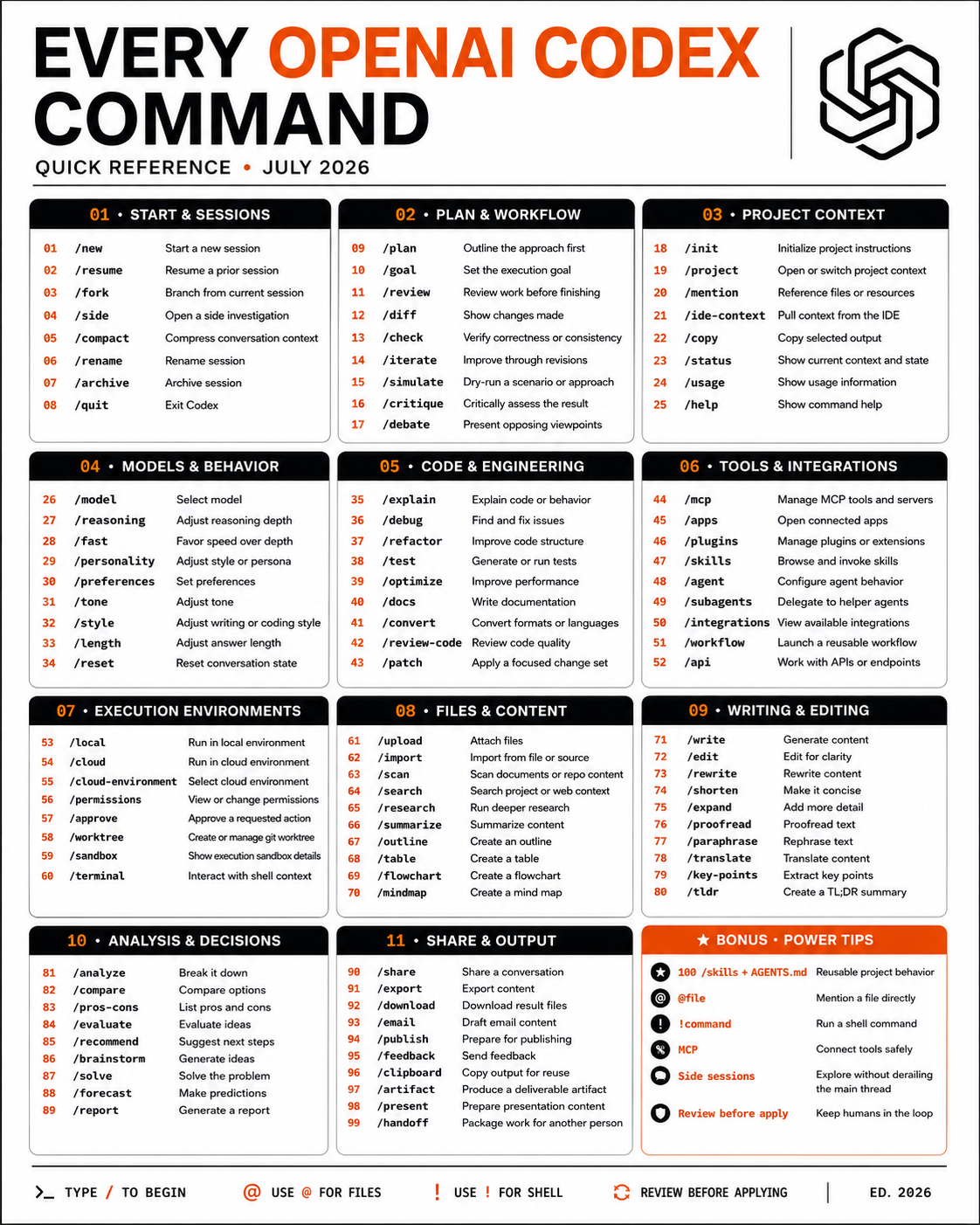
A practical guide to Codex surfaces, `AGENTS.md`, reference Markdown files, context loading, and the instruction priority stack that shapes output quality.
Open guideSurface, instructions, context loading, and priority in one model.
Surface
CLI, IDE, cloud, and ChatGPT Codex each fit a different working style.
Instructions
Behavior rules belong in the repo contract, not scattered across docs.
Loading
Codex pulls the relevant docs and files when the task moves there.
Priority
The current prompt and task framing outrank passive repo context.
A practical guide to the difference between AI governance and compliance, the framework stack around them, and what changes once agents and runtime controls enter the picture.
Open guideStrategy, proof, agent controls, and human oversight in one operating model.
Governance
Principles, roles, escalation paths, and long-term AI operating decisions.
Compliance
Logs, evidence, registrations, and regulator-ready technical controls.
Agents
Tiered autonomy, checkpoints, and bounded execution for live agent behavior.
Humans
Board visibility, review quality, training, and challenge when AI output looks polished.
A detailed systems-engineering guide to LLMs, RAG, AI agents, and MCP. Built as a visual architecture reference for moving from demos to enterprise-ready AI systems.
Open guideFour systems: reasoning, grounding, execution, and secure connectivity.
LLM
Reasoning, drafting, interpretation, and language generation.
RAG
Verified retrieval from enterprise sources before the model answers.
Agents
Planning, tool use, execution loops, and corrective action in workflow.
MCP
Standardized connectivity between AI clients, tools, and governed data sources.
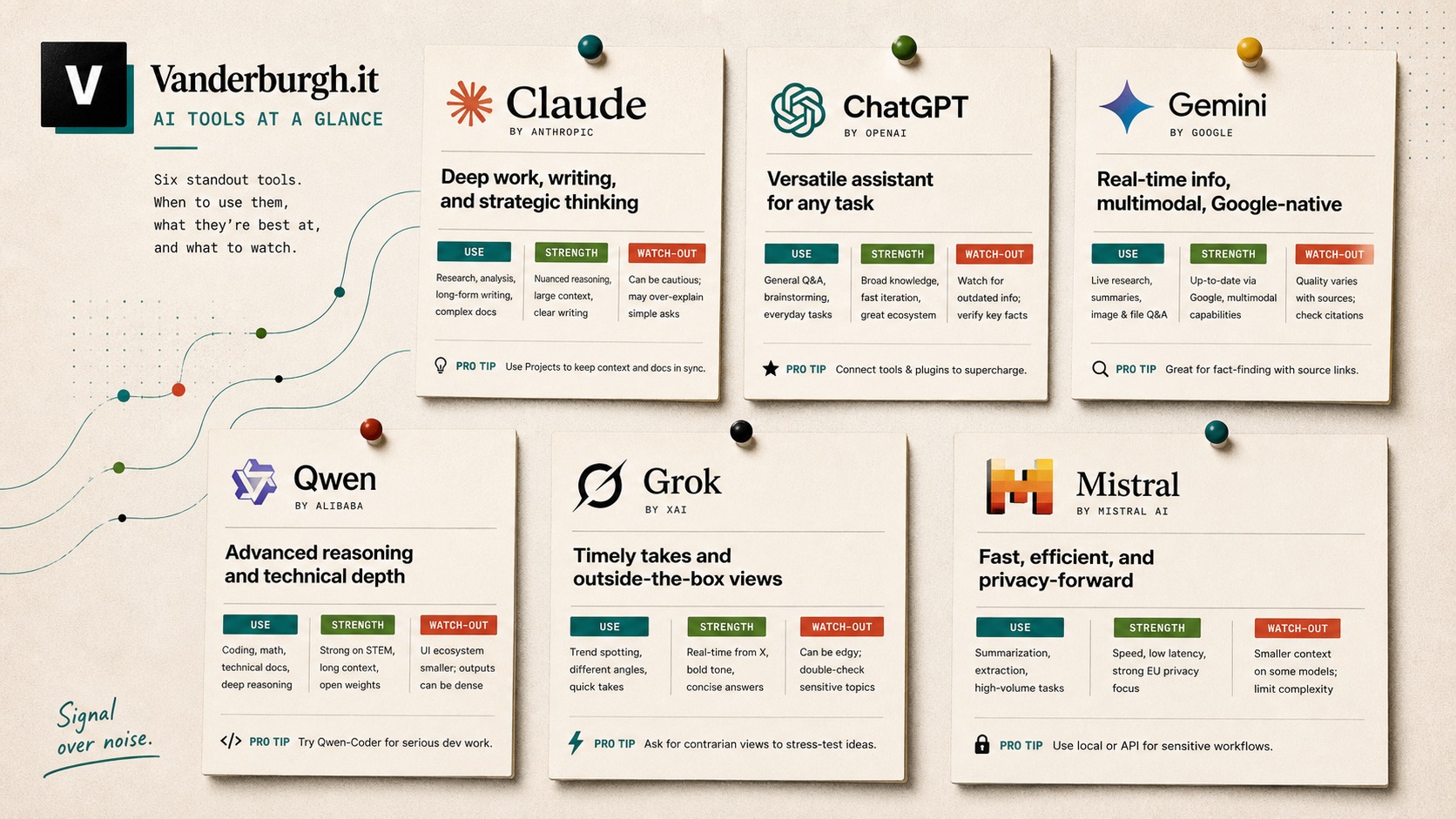
A practical comparison of Claude, ChatGPT, Gemini, Qwen, Grok, and Mistral. Use the card view as the quick scan, then open the matrix for strengths, limits, and best-fit work.
Open guide